AI in talent acquisition is no longer a futuristic concept, it’s here, it’s everywhere, and it’s often deeply embedded before most teams have fully unpacked what it’s doing.
But not all AI is created equal. The models, data sources, scoring logic, and candidate experiences behind different tools can vary wildly. That’s why the smartest teams aren’t just asking if a tool uses AI, they’re asking how.
This guide outlines 15 critical questions to ask any AI hiring platform before you buy, adopt, or scale. These aren’t just technicalities, they reveal how fair, trustworthy, and effective a tool really is. We’ve also included Vervoe’s perspective as a reference point for what thoughtful, transparent AI in recruitment can look like.
1. Fairness, Transparency & Trust
Q1: How does your AI handle bias, and what safeguards are in place?
This question gets to the heart of ethical AI. Tools that rely on resumes, historical hiring data, or opaque scoring logic risk perpetuating systemic bias. Ask how the tool is trained, how performance is monitored across candidate cohorts, and whether fairness is built into the product lifecycle, not just tacked on.
At Vervoe: Our AI is purpose-built to reduce bias by design. Instead of relying on resumes, we assess candidates through practical, role-specific tasks allowing them to demonstrate what they can do. We eliminate inputs that could introduce bias, and our scoring models are trained and fine-tuned using your team’s actual review data ensuring alignment with your standards, not historical assumptions. The data set used to train the model is completely transparent which ensures you can see all your training data in just one click.
Q2: How do I know the AI is being used ethically?
This is one of the most important and most overlooked questions to ask. A major red flag is when tools rely on generic large language models (LLMs) like ChatGPT to score candidates. LLMs are inherently biased, ever-changing, and not built for consistent, high-stakes evaluation. If the same candidate took an assessment today and again next week, their outcome might change, and not because they did anything differently.
Ethical AI in hiring requires transparency, control, and consistency. To truly assess this, ask:
- What training data was used to build the model?
- Can I train the model myself so it reflects our standards?
- Can I view, override, or flag data if I see inaccuracies or bias?
At Vervoe: Our AI doesn’t rely on generic LLMs. Instead, we give you complete control through a feature called Active Learning, a dedicated interface where you can train your assessment models based on real candidate responses. Training happens in a blind environment (no names, no identifiers), so feedback stays focused on quality and skill, not unconscious bias. You can instantly view the full training dataset for any question: every past response, how it was graded, and by whom. If something looks off, you can flag or override the grade and the model will retrain immediately based on that input. This means the AI behaves the way you want it to, with full transparency and traceability baked in.
Q3: Can you explain AI-led decisions to candidates, legal teams, and execs?
Explainability isn’t a luxury, it’s a legal and ethical necessity. If a candidate questions their score, or an exec wants to understand the decision-making, you need more than “the AI said so.” Look for vendors who can surface scoring logic in human terms.
At Vervoe: Hiring teams can see how responses were graded, including model confidence levels and score breakdowns. We’re actively evolving our Explainable AI features to support compliance and candidate trust.

Q4: How is candidate data handled?
Privacy is more than a checkbox. It’s a trust signal. Make sure you understand where candidate data is stored, who has access to it, and whether candidates can update or delete their records.
At Vervoe: We take a privacy-first approach. Candidate data is only ever used to support fair, skills-based evaluation never for unrelated profiling or AI training across customers. We retain only essential identifiers: name, email address, and location (if provided). All other data relates directly to the assessment itself such as responses, scores, and interaction history and is stored securely within your private, siloed dataset. Our platform is fully compliant with global regulations like GDPR, and for enterprise clients, we support regional data hosting and custom retention policies.
Q5: Are AI decisions traceable and legally defensible?
This is especially important in regulated environments like government or large enterprises. If a hiring decision is contested, can your vendor show how and why it was made?
At Vervoe: Every decision made by our AI is backed by a transparent scoring process. Hiring teams can view candidate responses, scoring breakdowns, and model confidence levels all of which can be shared with legal, compliance, or audit teams if needed. Importantly, our AI doesn’t operate in a black box, it’s trained and refined using your team’s real hiring data. That means the way candidates are evaluated reflects your standards, not generic benchmarks. This level of customisation makes it easier to stand behind decisions and explain outcomes with confidence.

2. Performance, Integration & Scalability
Q6: Has the AI been tested across industries, roles, and cultures?
One-size-fits-all tools rarely serve diverse hiring environments well. Look for evidence of adaptability, not just claims. What industries has the platform worked in? Are there examples of success with different candidate demographics?
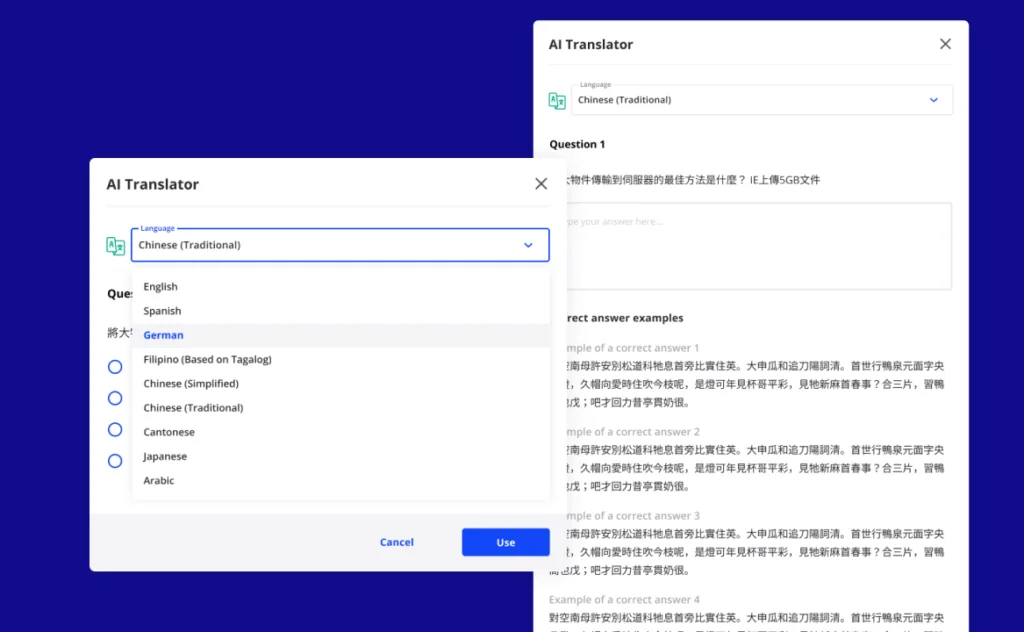
At Vervoe: We work across finance, professional services, logistics, government, and tech in 15+ countries and multiple languages. From frontline hires to grad programs, our platform flexes to fit the hiring context.
Q7: How does the platform integrate with existing systems?
Integration issues cause friction, poor adoption, and dirty data. Ask about ATS compatibility, customisation, and support during implementation.
At Vervoe: We offer integrations with Workday, PageUp, Smart Recruiter, JobAdder, Lever and more. Our team handles onboarding closely to avoid data mismatches and delays.
Q8: Can performance stay consistent as business needs evolve?
Hiring strategies change, your assessment tool should keep up. Ask how the AI evolves, how updates are managed, and whether you’ll need external support to adapt.
At Vervoe: Our assessments are fully editable, with support for revalidation, benchmarking, and live feedback loops from hiring managers.
3. Insight, Learning & Evolution
Q9: Can the AI predict outcomes beyond screening, like performance or retention?
It’s one thing to filter applicants. It’s another to find the ones who’ll thrive. Ask if the platform has any link between assessment performance and real-world job success.
At Vervoe: Many clients track assessment results against outcomes like performance, retention, and training speed. Our Closing the Loop feature helps refine assessments over time using post-hire data.
Q10: How do you keep the AI aligned with evolving skills?
Static assessments go stale fast. Ask how often question banks and scoring models are refreshed, and whether you can customise content yourself.
At Vervoe: We update regularly based on usage trends and customer input. Clients can also edit assessments themselves or work with our team for tailored updates.
Q11: How do you handle low-data environments or new roles?
Some tools need historical hiring data to function. That’s a problem when you’re hiring for brand-new roles or experimenting with new strategies.
At Vervoe: Our AI benchmarks candidates against the cohort completing the same assessment. No legacy data required.

4. Human Impact & Role Evolution
Q12: How will AI change recruiter and hiring manager roles?
AI should support better decisions, not remove the human from hiring. Ask how the platform empowers your team with data and insight.
At Vervoe: Recruiters spend less time screening and more time engaging. Hiring managers get data-backed shortlists, freeing them up for higher-value conversations.
Q13: Are non-traditional candidates getting a fair shot?
If the AI favors those with the “right” resumes or backgrounds, it’s not inclusive. Ask how the platform supports equity and fairness at scale.
At Vervoe: By assessing what people can do, not where they’ve been, we’ve helped clients like Bank of Queensland and Team Global Express increase diversity across gender, education, and generation.
5. Cost, Value & Simplicity of AI in Talent Acquisition
Q14: What’s the cost of doing nothing?
This is about urgency. Poor-fit hires, delayed recruitment, and attrition all cost more than you think. A good AI tool should pay for itself in both efficiency and quality of hire.
At Vervoe: Our customers have seen time-to-hire halved, retention increased, and performance improved – all measurable outcomes from switching to skills-first hiring.
Q15: What manual tasks can we automate or remove?
If your team is still doing resume screening or generic phone screens, ask whether the platform can replace those steps without losing insight.
At Vervoe: Most customers eliminate phone screens and early interviews altogether. One-on-one time is used for assessing motivation and fit, not skills.
Choosing an AI hiring platform isn’t just a tech decision, it’s a trust decision. These questions help you cut through the noise, challenge assumptions, and ensure the tool you choose actually makes hiring better. To understand more about Vervoe and our AI capabilities, Book a Demo with us today.