Many enterprise TA leaders often feel stuck in a never-ending race, pushed to fill roles faster than ever while the skills required for those roles shift constantly. The business expects immediate results, yet traditional hiring leaves recruiters reacting to emergencies with little clarity on what talent is truly needed next.
To break this cycle, forward-thinking organizations restructure their approach by building talent pipelines around skills for the future, rather than job titles. In this article, we’ll explore why talent pipelines break down and how skills-based hiring helps TA leaders stay ahead of demand and consistently hire better.
TL;DR
Enterprise talent pipelines fail when hiring relies on resumes, reactive workflows, and inconsistent evaluation. Skills-based hiring fixes this by measuring real capability early in the funnel giving TA teams better data, stronger candidates, and pipelines that hold up as role requirements change.
In this article:
- Why enterprise talent pipelines break down (4 root causes)
- What a future-ready pipeline looks like
- 5 steps to build one using skills-based hiring
- What to look for in enterprise recruitment software
Why enterprise talent pipelines break down
Failing talent pipelines are usually more of a result of challenging hiring environments and inadequate planning than a lack of team effort, especially in high-volume recruiting. Knowing common breakdown points shows you what to expect so that you can adjust your hiring strategy accordingly. In this section, we’ll discuss the top reasons enterprise talent pipelines break down.
1. Unreliable metrics from traditional hiring methods
Resume keywords, past job titles, and surface-level credentials rarely reveal a candidate’s actual capability. In fact, an Equifax survey found that 71% of HR professionals have encountered fabricated or misleading information during hiring, highlighting how unreliable these traditional signals can be.
Because these methods don’t capture true skill, TA teams struggle to compare applicants fairly or predict performance correctly. Stronger candidates get overlooked in favor of polished profiles that don’t necessarily reflect capability.
As more qualified applicants are filtered out early, the talent pool shrinks, leaving recruiters scrambling to fill roles with limited options and minimal time.
2. Slow, reactive hiring
When hiring is driven by urgent requisitions instead of long-term planning, the process slows down and pressure mounts. Recruiters must source, screen, and interview in real time while balancing conflicting demands, which makes every step feel rushed and inefficient, leading to hiring delays.
Meanwhile, candidates sense this lag too. A Traffit survey reports that 40% of candidates lose interest when the hiring process drags, causing drop-offs before decisions are made. Reactive workflows ultimately drain recruiter capacity and weaken the talent pipeline long before it can mature.
3. Poor workforce planning due to insufficient skills data
In a 2024 HR.com survey, only 26% of respondents agreed their recruitment data is correct, and just 30% said it is complete. While 67% found the data useful, most admit it’s flawed, meaning decisions were often based on partial or inaccurate data.
Without clear, up-to-date insight into what skills the organization has and which ones it will need next, TA leaders are forced to make short-term decisions. Guesswork fuels hiring instead of strategy, and teams end up filling immediate gaps rather than preparing for future needs.
This lack of visibility makes it almost impossible to build pipelines that align with business growth or emerging skills.
4. Inconsistent evaluation across teams
65% of HR managers in PXT Select’s survey admitted to relying more on instinct than data when making hiring decisions, which creates inconsistency from the start. Even for the same role, hiring managers evaluate candidates differently, leaning on personal preferences or interpretation rather than shared standards.
While diverse perspectives can strengthen hiring, inconsistent criteria lead to disjointed experiences, uneven quality, and unclear expectations. Without defined requirements or aligned evaluation methods, the process becomes hard to track, difficult to replicate, and vulnerable to errors in judgment.
Consequently, talent pipelines and hiring funnels become fragmented, and great candidates get ruled out simply because the process isn’t aligned.
Characteristics of a future-ready talent pipeline

Building a future-ready talent pipeline isn’t just about reacting to today’s open roles. The most effective pipelines give TA leaders foresight by identifying the skills the organization will need tomorrow and keep top talent ready when demand arises. To achieve this, here are three essential characteristics every forward-looking pipeline should have.
1. Dynamic, competency-based talent pools
Instead of static candidate lists that focus on titles or pedigree, modern pipelines organize talent by skills and capabilities. Competency-based pools allow recruiters to see who can perform a task today, who could grow into it, and who has transferable skills.
With this approach, it’s easier to match candidates to multiple roles, reduce time-to-hire, and plan for future needs without the last-minute rush. Here’s what this looks like in a typical hiring environment:
- Tags or categories for specific skills such as Python, project management, or customer research
- Ability to search and filter talent by skills, proficiency levels, or potential
- Cross-role visibility to identify candidates suitable for multiple positions
- Quick identification of internal talent for mobility or succession planning
2. Real-time predictive skills data
Talent pipelines thrive on accurate, current information. By continuously tracking the skills present in the organization and emerging skills in the industry, TA leaders predict where gaps will appear before they become urgent.
Precise data helps the team prioritize the right skills, source candidates efficiently, and plan for succession early instead of constantly reacting to immediate needs. Data-driven pipelines should have the following features:
- Recruitment analytics software with a dashboard showing detailed skills coverage across teams, including who has what skills and where gaps exist
- Alerts when a key skill is high in demand externally or internally
- Regular reports to plan sourcing or internal development based on upcoming projects
- Historical data on how long certain skills or roles take to fill
3. Continuous candidate evaluation
The most effective talent pipelines are constantly moving and evolving, not dormant with rare check-ins. When there’s consistent evaluation and communication with candidates who show potential, they stay motivated, engaged, and ready to take on new roles.
This ongoing assessment builds a stronger, more resilient pipeline, improves candidate experiences, and reduces the risk of losing top talent to competitors. Here’s what the evaluation process should involve:
- Regular check-ins or automated emails to keep candidates engaged
- Continuous skills assessments to track progress or readiness for new roles
- Flags for candidates who may be ready for positions they weren’t initially considered for
- Feedback records so hiring teams know exactly where each candidate stands
How to build a future-ready talent pipeline

Building a future-ready talent pipeline requires practical, intentional steps that help you understand your organization’s current skills, gaps, and how to evaluate talent consistently. In this section, we’ll discuss five steps every TA team should take to build a future-ready talent pipeline with practical examples that reflect real hiring workflows.
1. Audit your current workforce
Before you can predict future hiring needs, you need a clear picture of your existing talent. Many organizations assume they know the skills their teams have, but most skill sets are undocumented, outdated, or scattered across systems.
Carrying out a proper audit gives TA leaders a realistic baseline to work from and determine where the team is lacking. Follow these guidelines to carry out a full skills audit that provides detailed, actionable results:
- Create a list of departments, roles, and role responsibilities.
- Clarify what skills employees in each role currently possess.
- Run a skills survey or self-assessment for employees to capture undocumented abilities.
- Validate those skills through manager feedback or internal assessments.
2. Identify your required skills
After identifying what skills you have, map them against your organization’s goals, industry’s future direction, and emerging trends to highlight existing gaps. Beyond filling today’s vacancies, this aligns your organization with the external business landscape and shows you the skills required to stay competitive.
With this step, you keep up with fast-paced changes and position your organization as an industry leader. Here’s a step-by-step guide to help you:
- Review periodic business plans and industry reports to identify skills tied to future goals.
- Meet with functional leaders to list critical skills that are growing in relevance.
- Distinguish between must-have and nice-to-have skills for each role.
- Create or update skills profiles and job descriptions to reflect what each role truly requires.
- Determine which skills can be built internally and which must be hired externally.
3. Introduce skills assessments early in the funnel
Identifying skills gaps will yield little result without accurate, reliable hiring methods to test for competencies. Measuring candidates’ real ability early filters quality talent from the larger applicant pool, streamlining your focus without hiring bias.
This provides objective data, enables faster hiring without compromising quality-of-hire, and ensures fewer mismatches when making hiring decisions.
Also, introducing skills assessment tests early in the funnel lets you evaluate a wider, diverse group of candidates for your preferred skills. This way, you can spot unconventional applicants with potential who would usually be overlooked.
Here are important pointers to note when testing skills:
- Choose validated assessments with real job tasks and not generic personality tests.
- Add the assessment link directly into the application or early in the hiring funnel.
- Create score thresholds for progressing applicants and reviewing candidate profiles.
- Train hiring managers to interpret assessment results correctly.
- Iterate and update assessment tasks to reflect evolving role requirements.
4. Build dynamic, skills-based talent pools
A static list of potential candidates quickly becomes outdated relative to emerging skills. Keep your pipeline moving with regular candidate communication and evaluations for the competencies your business and industry prioritizes for future projects.
With a dynamic, skills-based talent pool, you can match candidates to multiple roles, track their growth, and quickly surface the right people when needs change. Here’s a simple guide for you:
- Group candidates by skills, assessments, and proficiency levels in your hiring software.
- Create pools for similar skill clusters.
- Set reminders to re-engage top candidates monthly or quarterly.
- Add new assessment results or updated resumes to keep profiles fresh.
- Note which candidates are ready to work and those that need upskilling or reskilling.
- Share these updated pools with hiring managers during workforce planning.
5. Use predictive talent intelligence for workforce planning
Predictive talent intelligence helps you anticipate future workforce needs and plan for them accurately. Using AI-powered recruitment analytics software, you can run detailed analyses of candidates’ skill profiles, monitor trends to identify gaps, and build pipelines to fill them ahead of time.
Instead of waiting for vacancies to appear, predictive intelligence provides expert data that tells you when skills run short or when demand will spike. Subsequently, you can plan sourcing or internal development well in advance.
Take these steps to plan your workforce using predictive intelligence:
- Use analytics tools that track internal skills coverage and external market demand.
- Set alerts for roles or skills with high attrition rates.
- Analyze time-to-fill and market supply to identify where early sourcing is needed.
- Forecast hiring needs based on upcoming projects or organizational growth.
- Reskill and upskill employees to close skills gaps identified during audit.
- Prepare a periodic skills outlook report to drive decision-making.
A future-ready talent pipeline isn’t built in one overhaul. Rather, it requires a series of practical, consistent steps. By grounding your strategy in real data, skills-based assessments, and constant reevaluations, you make your hiring faster, accurate, and resilient as roles and skill needs keep evolving.
How skills-based hiring leads to better quality talent

When building a future-ready pipeline, how you evaluate candidates affects the efficiency of your system. In enterprise hiring, traditional methods like resume screening and unstructured interviews not only reduce quality-of-hire but also break down at scale. Here’s how skills-based hiring helps you find and hire better quality talent for your pipeline.
1. Objective candidate evaluation
Traditional screening relies heavily on resumes, keywords, and past job titles, all of which can be inflated, misleading, or irrelevant to the actual work. At enterprise scale, this creates inconsistent shortlists and adds noise to the funnel.
Skills-based hiring replaces that guesswork with structured, task-based evaluations that measure real capability. Instead of assuming competence from credentials, you can compare candidates using the same criteria, eliminating bias and creating consistent, high-quality decisions across every role.
2. Better performance prediction
Experience doesn’t guarantee future performance, especially in fast-changing industries. Traditional hiring emphasizes pedigree, background, or demographics, which often have little correlation with on-the-job success.
Skills-based hiring focuses on how well a candidate can perform job-relevant tasks in the current work environment, allowing for more efficient talent pools. This shift gives enterprise teams a far more accurate read on performance potential and reduces misalignment between expectations and actual results once the candidate is hired.
3. Early identification of transferable skills
Standard screening filters out many strong candidates simply because their resumes don’t match a narrow set of keywords or titles. Enterprise roles, however, increasingly require adaptability and cross-functional skills.
Skills-based hiring uncovers transferable strengths early, whether analytical ability or technical problem-solving, that traditional processes miss. This expands the available talent pool and makes it easier to redeploy, upskill, and future-proof teams.
4. Improved candidate quality
When your process filters candidates by actual ability and not assumptions, the talent that moves through the pipeline is consistently stronger. Traditional hiring often advances candidates based on polished resumes or interview confidence rather than performance.
Meanwhile, skills-based hiring flips that dynamic, progressing only candidates who demonstrate capability. This raises the overall quality-of-hire, reduces training time, and builds a healthier long-term talent pipeline across the organization.
Recruitment software features for higher candidate quality

Choosing the right enterprise recruitment software is just as important as choosing the right hiring strategy. Even the strongest skills-based approach will fall apart if the technology behind it can’t scale, integrate, or provide trustworthy results. Here are the features that matter most for candidate quality.
1. Transparent AI models
Traditional tools that fail to explain how they generate scores create compliance risks and make it harder for TA leaders to defend their candidate choices. With black-box AI, recruiters don’t understand why top candidates are highly ranked, which means they can’t spot errors in the algorithm or confirm its decisions.
Transparent AI gives teams insight into why a candidate scored a certain way, how the model evaluates skills, and what data influences the outcome. This ensures hiring remains fair, explainable, and aligned with internal standards, all of which are crucial for accurate hiring in enterprise HR teams.
2. Flexible, validated assessments
In large organizations, many roles involve niche, high-stakes tasks, making software with generic tests insufficient for predicting job performance.
Good assessment tools must be validated against the specific roles, environments, and hiring conditions inside the organization to ensure they measure what success actually looks like. Role-aligned tasks give TA teams reliable proof of capability from the start.
Enterprise roles also evolve quickly, which means grading criteria should be easy to update as skill requirements, workflows, or tools change. When evaluation is based on job demands, hiring remains consistent and efficient, reflecting how the work is truly done.
3. Enterprise-grade scalability
As hiring needs grow, many traditional tools become slow, unreliable, or difficult to manage. Enterprise recruitment software must handle large candidate volumes, distributed teams, and complex workflows without breaking down.
Using scalable software ensures assessments run smoothly, scoring remains accurate, and pipelines stay organized even during peak hiring periods. This prevents bottlenecks and keeps the entire talent pipeline moving efficiently.
4. Seamless integrations
In enterprise environments, HR teams rarely work with standalone solutions and usually have an organized ecosystem made up of multiple hiring tools. If your skills validation software doesn’t integrate with existing tools and communication platforms, data gets lost, leading to a break in the hiring cycle.
Seamless integrations ensure candidate information, assessment results, and skill insights flow across the organization with little manual effort. This reduces admin work, shortens time-to-hire, and gives TA leaders a single, unified view.
5. Data privacy and compliance
Enterprises operate under strict regulatory and internal governance requirements, making data handling a top concern. Traditional systems that store candidate data without clear controls can introduce ethical, legal, and reputational risk.
Skills validation software for enterprise HR teams should offer robust data protection and comply with global AI regulation and privacy standards such as GDPR and EEOC. This protects the organization and builds candidate trust, leading to a stronger candidate experience.
Frequently asked questions
What is a talent pipeline in hiring? A talent pipeline is a pool of pre-screened, qualified candidates an organisation can draw from when roles open. A future-ready pipeline organises candidates by skills and proficiency rather than job titles, so recruiters can match talent to multiple roles quickly without starting from scratch each time.
What is skills-based hiring? Skills-based hiring is a recruitment approach that evaluates candidates based on demonstrated ability to perform job-relevant tasks — rather than relying on credentials, job titles, or years of experience. It uses structured assessments to measure real capability and generate objective, comparable data across candidates.
Why do enterprise talent pipelines fail? The most common reasons are: unreliable screening methods that miss strong candidates, reactive hiring driven by open requisitions rather than workforce planning, poor visibility into skills gaps, and inconsistent evaluation standards across hiring teams. Together, these create pipelines that are slow to build and quick to drain.
How does skills-based hiring improve quality of hire? By filtering candidates on actual job performance rather than resume signals, skills-based hiring progresses only those who’ve demonstrated capability. This reduces mismatches, cuts onboarding time, and produces stronger performance outcomes — particularly in high-volume or fast-changing enterprise roles.
What is a competency-based talent pool? A competency-based talent pool organises candidates by skills, proficiency levels, and transferable abilities rather than previous job titles. This allows TA teams to identify suitable candidates for multiple roles, track development over time, and surface the right people quickly when hiring needs shift.
What should enterprise recruitment software include? Key features for enterprise hiring include: transparent AI that explains how candidates are scored, validated role-specific assessments, scalability for high-volume hiring, integrations with existing ATS and HR tools, and data privacy compliance (GDPR, EEOC). Generic tools that rely on black-box scoring or static templates create risk at scale.
How do you build a skills-based talent pipeline? Start with a workforce audit to document current skills. Map those against future business goals to identify gaps. Introduce skills assessments early in the hiring funnel. Build dynamic talent pools organised by competency. Then use predictive analytics to anticipate where demand will spike before roles go vacant.
Build future-ready pipelines early with Vervoe
The strength of your talent pipeline depends on the systems behind it. When enterprise hiring teams rely on outdated tools, generic assessments, or black-box AI, pipeline quality declines fast, highlighting the need for reliable recruitment software.
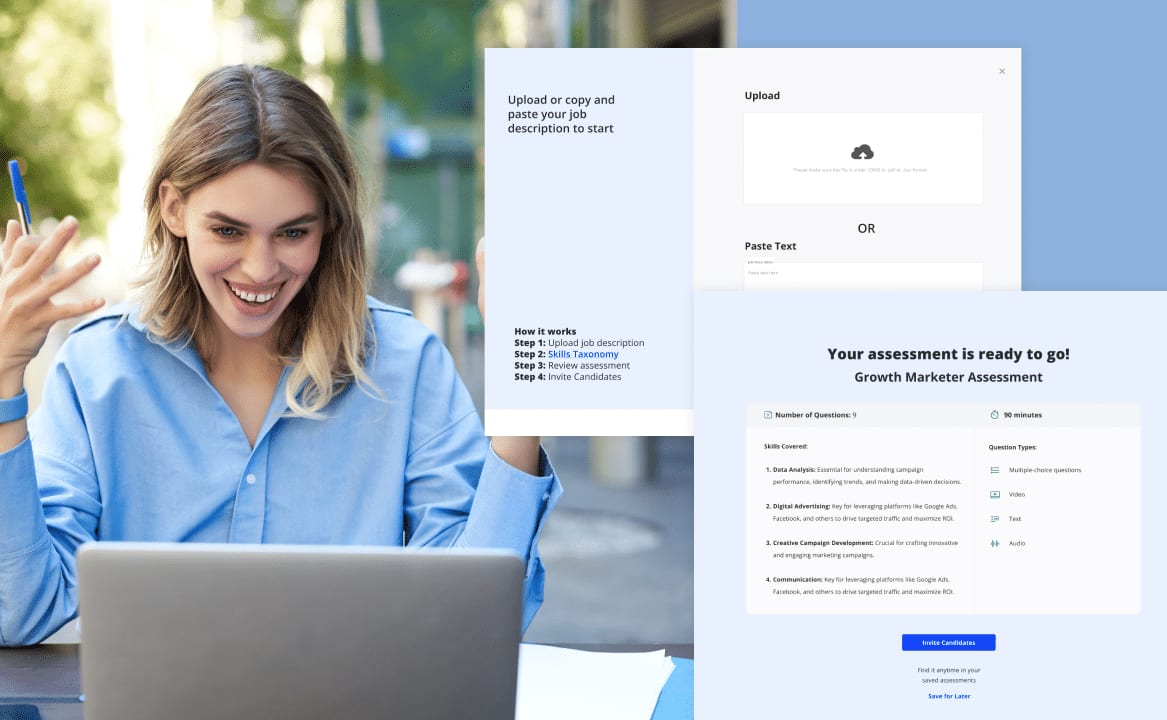
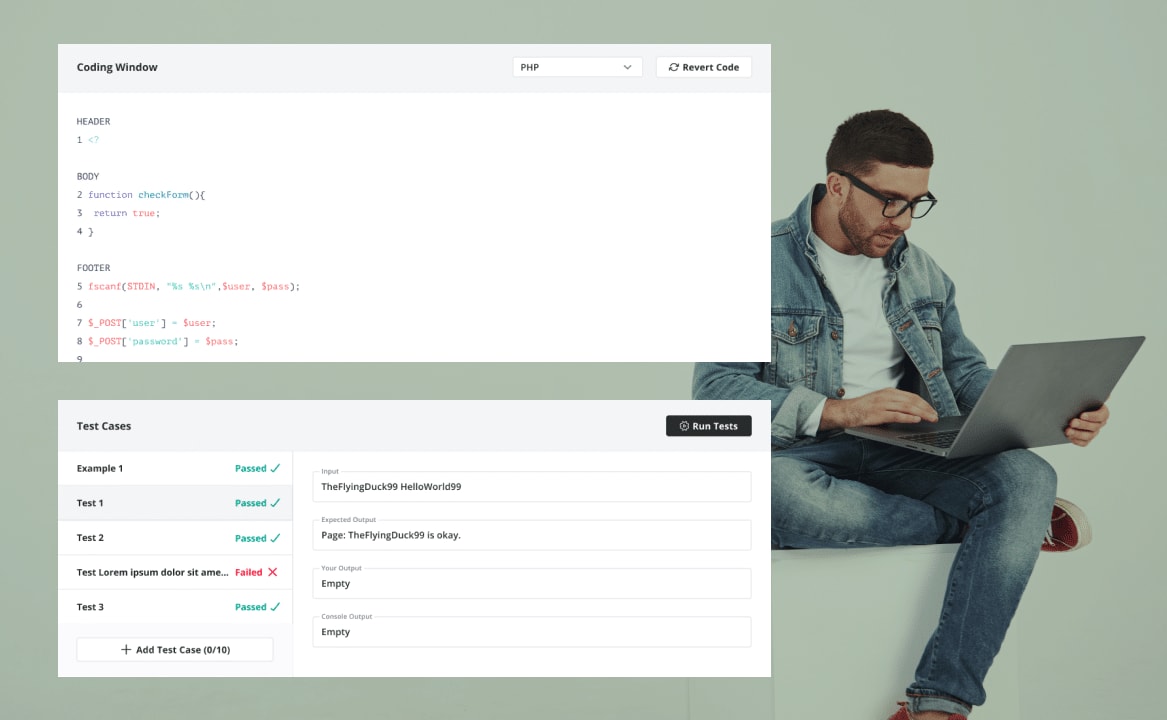
Vervoe offers customisable job-specific assessments that measure real ability and allow you to adjust your criteria as job needs change. Our transparent AI is accurate and trustworthy, showing exactly how skills influence grading and ranking. Additionally, Vervoe offers enterprise-grade scalability, integrations, and data protection to ensure hiring stays seamless and compliant, no matter your candidate volume or team size.
See how Vervoe strengthens your pipeline from the very first assessment. Schedule a demo and experience a smarter, futuristic, and reliable way to hire.